
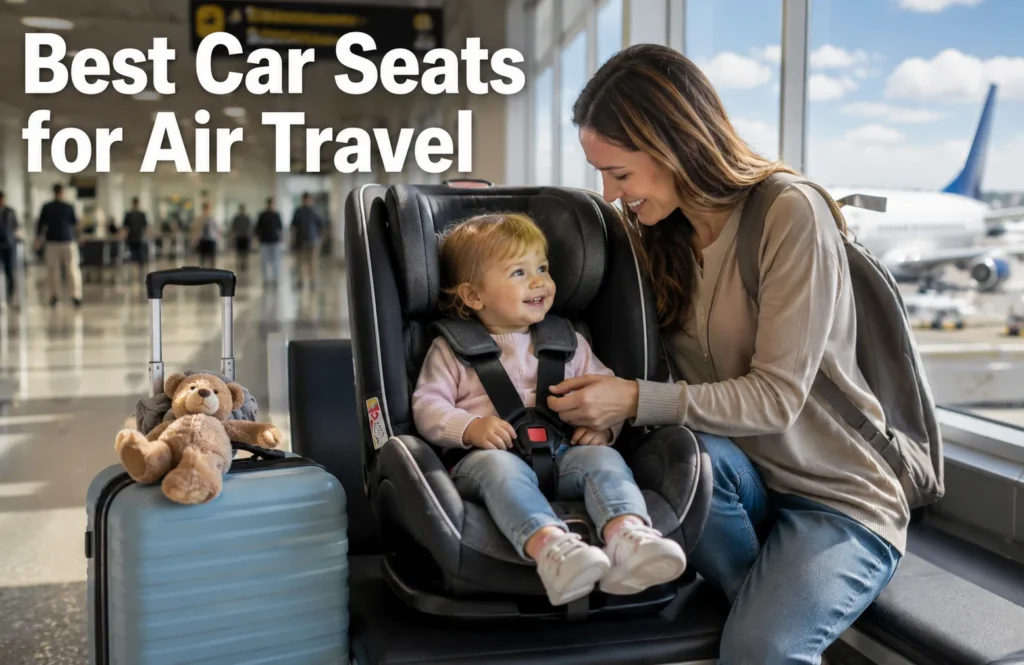
Flying with a young child is hard. It gets harder if your car seat won’t fit. The best car seats for air travel must be light. They must be narrow enough for a plane row. They must also be safe and FAA-approved. Many parents learn too late that their home car seat is just too big for a flight.
I compared expert reviews. I checked the owner’s feedback. I read FAA rules, too. This helped me find five seats that work well for flying. Each one fits a different kind of family, from babies to toddlers to grade-schoolers. You’ll find honest pros and cons for each one below. Pick the seat that fits your trip, not just your budget. For your family trip with your children easy and convenient Download Free Printable Packing List.
Best Overall: WAYB Pico Car Seat
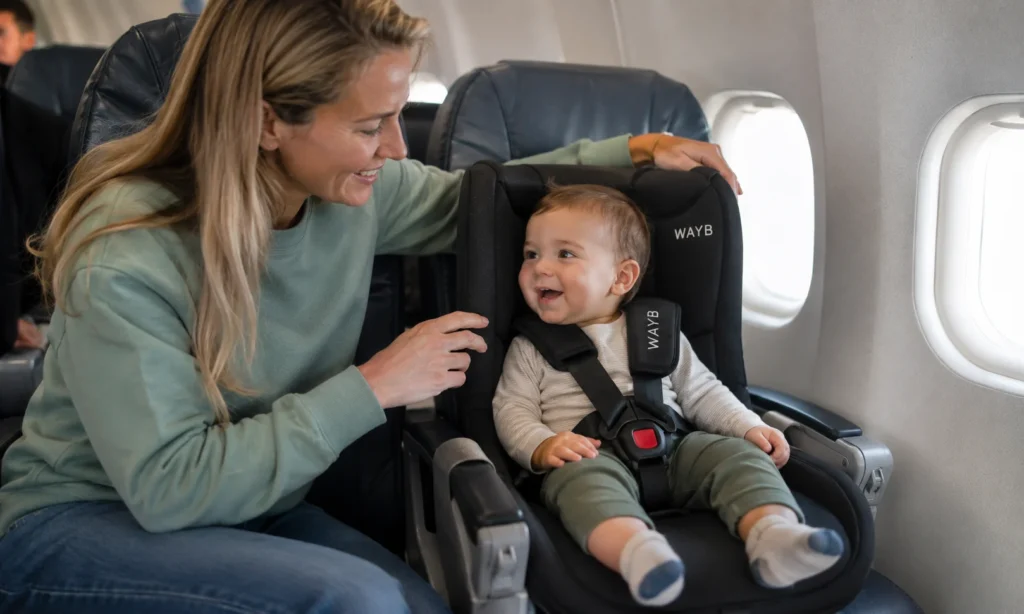
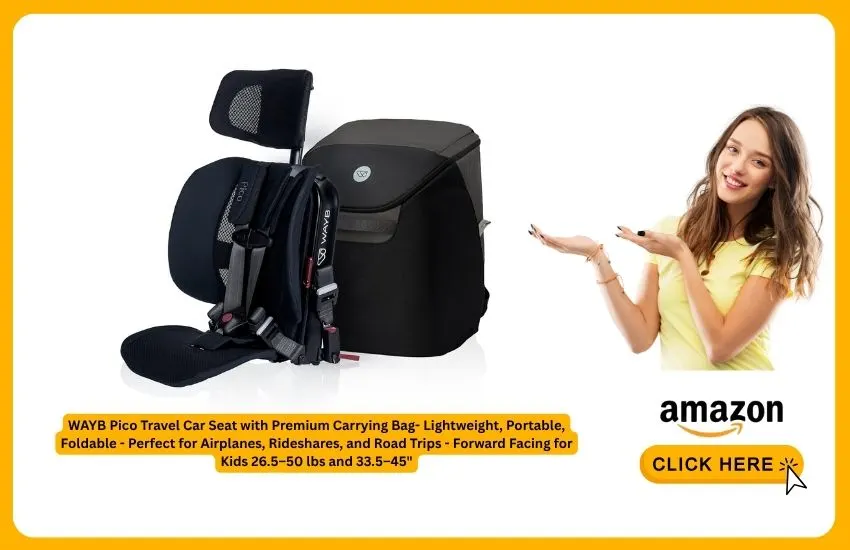
The WAYB Pico is a top pick for flying families, and it’s easy to see why. It weighs about 8 pounds. That makes it the lightest harnessed seat on this list. It folds flat and fits in an overhead bin. WAYB is a newer travel-gear brand. The team built the Pico just for planes and airports, not for daily use at home.
It fits kids from 22 to 50 pounds, at heights of 30 to 45 inches. That covers most kids ages 2 through 5. It’s a frequent pick among the best toddler car seats for air travel. So if you’re hunting for the best airplane car seat for a 2 year old, this is a strong choice.
Pros and Cons
Here’s how the Pico holds up once you look past the photos.
| Feature | Pro | Con |
| Weight | Only about 8 pounds to carry | Some parents want a sturdier feel |
| Portability | Folds flat, fits in overhead bins | The matching travel bag costs extra |
| Comfort | Fine for short flights and car rides | Not great for naps on long trips |
| Setup | Quick to install with LATCH or a belt | A bit slower than top premium seats |
| Price | Holds its resale value well | One of the priciest travel seats around |
Recommendation
Families who fly a lot say the Pico is worth its price. It takes up very little space, both in a suitcase and on a plane. It won’t replace your seat at home, though, and it’s not great for naps on long flights.
If you only fly once or twice a year, the cost is harder to justify. But for families who fly often with a toddler, it solves a real problem. Most other seats can’t.
Best for: Families who fly often with a toddler between 2 and 5 years old.
Not ideal for: Occasional flyers, or kids who need to nap well on board.
Best Value: Cosco Scenera Extend
If budget matters most, this is your pick. Cosco is a Dorel Juvenile brand, sold mainly at Walmart. It’s known for simple seats that meet every safety rule, at a low price. The long-time favorite Scenera Next is being phased out. The new Scenera Extend takes its place. It has a taller shell and meets the newer side-impact safety rule, too.
It weighs about 8 to 9.5 pounds and is about 18 inches wide. That’s still narrow enough for most plane rows. This makes it a top pick among convertible car seats for air travel, and it won’t break your budget.
Pros and Cons
A quick look at where this budget seat shines, and where it falls short.
| Feature | Pro | Con |
| Price | One of the cheapest FAA-approved seats | Feels basic next to pricier models |
| Weight | Light enough for easy carrying | A bit heavier than the seat it replaces |
| Padding | Enough for short trips | Thin compared to everyday car seats |
| Safety | Meets the newer side-impact rule | No extra foam padding inside the shell |
| Harness | Simple five-point harness | Needs hand rethreading as your child grows |
Recommendation
After comparing owner reviews, the Scenera Extend stands out. It’s the easiest seat to buy twice: one for home, one just for trips. It rear-faces most toddlers past their second birthday. It forward-faces well past that, too, so one seat covers a wide age range.
It won’t feel plush, and you’ll need to adjust the harness by hand as your child grows. But for the price, it’s hard to beat among car seats for airplane travel.
Best for: Budget-minded families who want an FAA-approved seat at a low price.
Not ideal for: Parents who want a no-rethread harness or extra-soft padding.
Best for Infants: Chicco KeyFit 35
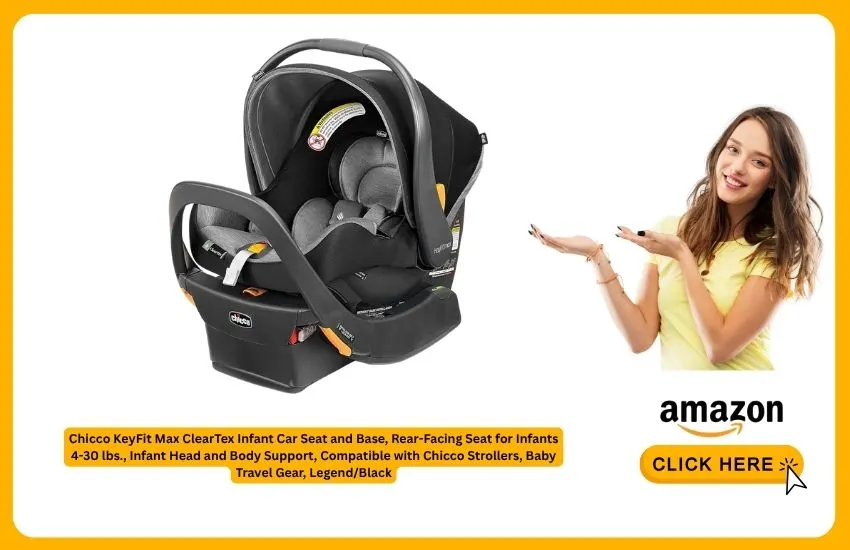
For babies, a bucket-style infant seat is often the easiest way to fly. It clicks in and out of its base, so you won’t wake a sleeping baby. Chicco is one of the biggest baby-gear brands in the world. This seat is a big reason why. The KeyFit 35 fits babies from 4 to 35 pounds. It also clicks into dozens of strollers to form a full travel set.
Pros and Cons
Here’s where the KeyFit 35 shines, and where it comes up short.
| Feature | Pro | Con |
| Setup | Base levels and locks in fast | The handle is awkward to carry |
| Weight range | Fits babies from 4 to 35 pounds | Outgrown sooner than a convertible seat |
| Stroller use | Clicks into many travel systems | Needs an adapter for other stroller brands |
| Comfort | Padded insert for small babies | No anti-rebound bar on this base |
| Portability | Lighter than many infant seats | Still needs a cart for long airport walks |
Recommendation
Expert reviews and owner feedback agree. The KeyFit 35 is a top pick for new parents. It’s one of the easier infant seats to install the right way. That matters most when you’re tired and rushing through security. Once your baby clicks in, you rarely touch it again until landing.
The catch: seats like this one only last until your baby hits 35 pounds. That’s often around age one. After that, you’ll need to move up to a convertible seat anyway.
Best for: New parents flying with a baby under 35 pounds who want an easy, snug install.
Not ideal for: Toddlers who have already outgrown the height or weight limit.
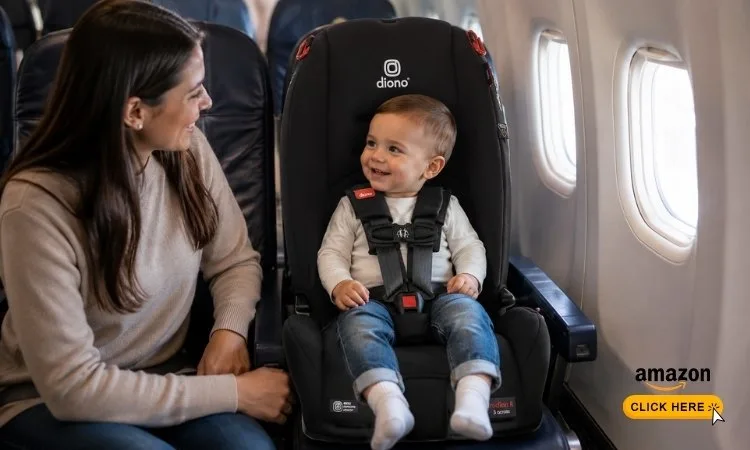
Best for Long-Term Use: Diono Radian 3R
Some families want one seat for years. Some need three seats in one row. For both, the Radian 3R is the clear winner. Diono is a Seattle brand founded in 1999. It built its name on slim, steel-core seats for big families and small cars alike.
The Radian 3R covers roughly 5 to 120 pounds across its three stages: rear-facing, forward-facing, and booster. It also folds flat for travel.
Pros and Cons
Here’s how this long-haul seat performs across the board.
| Feature | Pro | Con |
| Lifespan | Lasts from infancy through the booster years | Costs more upfront than a basic convertible |
| Width | Narrow enough for three-across seating | Tall shell can crowd a small front seat |
| Build | Steel core feels sturdy in owner reports | Heavier than seats built just for travel |
| Portability | Folds flat for planes and storage | No cup holders included |
| Comfort | Padded for long flights and drives | No infant insert for tiny newborns |
Recommendation
Long-term owner reviews back this up. The Radian 3R grows with your child instead of getting swapped out every year or two. It’s one of the few seats that truly fits three kids side by side. That solves a real headache for bigger families.
It’s heavier than seats made just for travel. So it’s not the lightest thing to carry through security. But if you want one seat to last a decade, the extra weight is a fair trade.
Best for: Families who need one seat for years, or who want three seats in a row.
Not ideal for: Parents who want the lightest option for short, rare trips.
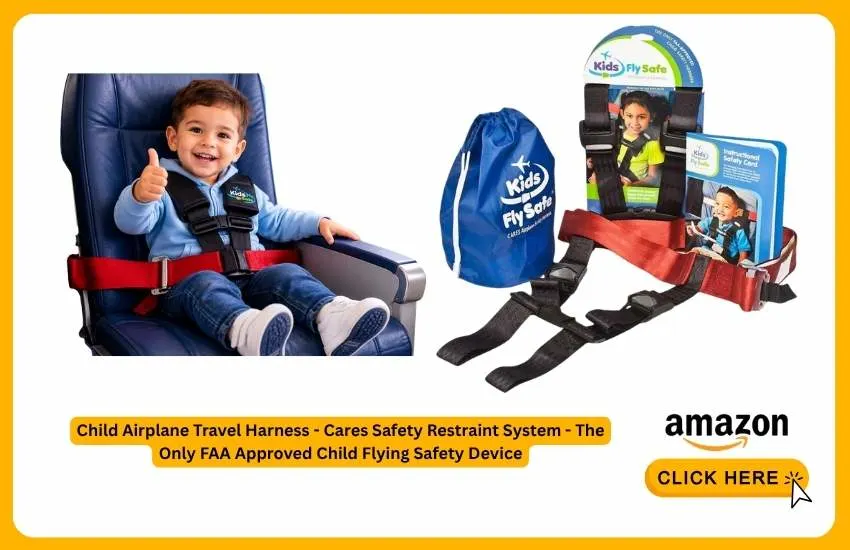
Best Lightweight Pick: CARES Harness
This last pick isn’t a car seat at all, and that’s the point. The CARES harness comes from AmSafe, an airplane-safety company, not a baby-gear brand. It’s the only harness-style device the FAA has approved for flight. It’s made for kids who can sit up alone but are still too small for a plain seatbelt. That’s usually kids from about 22 to 44 pounds.
Pros and Cons
Here’s what makes this light pick worth a look, and where it can’t help.
| Feature | Pro | Con |
| Weight | About 1 pound, fits in a small bag | Cannot be used in a car at all |
| Setup | Sets up on a plane seat in a minute | Only works on standard airline seatbacks |
| Approval | The only FAA-approved harness device | Doesn’t replace a car seat at your trip’s end |
| Age range | Fits kids around 22 to 44 pounds | Too small once your child passes the limit |
| Cost | Far cheaper than a full car seat | Offers less head and side support |
Recommendation
Long-term owner reviews say this is the best choice once your child no longer needs a bulky seat. It’s the lightest item on this whole list. For many families, it ends the hassle of dragging a seat through the terminal.
It won’t help once you land, since it can’t go in a car. If you’ll need a car seat at your destination, plan for that separately. Or pick another seat from this list instead.
Best for: Kids who fly often but won’t need a car seat once they land.
Not ideal for: Trips where your child also needs a car seat in a vehicle.
Best Car Seats for Air Travel: Comparison Snapshot
Here’s a quick side-by-side look at all five picks. Use it to narrow your choice before reading the full details above.
| Product | Best For | Key Trade-Off |
| WAYB Pico | Toddlers ages 2 to 5 who fly often | High price for a travel-only seat |
| Cosco Scenera Extend | Budget-minded families | Thin padding, basic features |
| Chicco KeyFit 35 | Infants under 35 pounds | Outgrown within a year or two |
| Diono Radian 3R | Long-term use or three-across rows | Heavier than travel-only seats |
| CARES Harness | Kids who won’t need a seat at the trip’s end | Aircraft use only |
How I Chose These Best Car Seats for Air Travel
I compared expert reviews from sites like BabyGearLab and Consumer Reports. I also read real owner feedback on parenting blogs and retailer sites. I did not crash-test these seats myself. Instead, I leaned on safety labs and FAA rules. I also looked for patterns that came up again and again in long-term reviews.
Weight and width came first. Those two things decide if a seat even fits on a plane. From there, I looked at price and durability. I also checked how each seat held up over months of real use, not just out of the box.
| Evaluation Factor | Why It Matters |
| FAA approval | Confirms the seat is certified for use in flight |
| Weight | Shows how easy it is to carry through an airport |
| Width | Affects whether the seat fits a standard plane row |
| Crash test data | Shows how a seat does beyond minimum safety rules |
| Owner feedback | Reveals comfort and wear after real-world use |
| Price | Affects whether a travel-only buy makes sense |
| Age and weight range | Shows how long the seat will stay useful |
Common Buying Mistakes
Even careful parents slip up when shopping for a travel car seat. Here are the mistakes that came up most in my research.
Many buyers pick a seat for its color or look before they check the FAA label. Others buy a seat that’s too wide for a coach row, then can’t get the armrest down. Skipping a practice install at home is another common one. So is checking the seat as luggage, where it can get damaged or lost. And some parents go by age alone. They miss that their child has already passed the seat’s weight or height limit.
| Mistake | Better Approach |
| Picking a seat for looks, not safety data | Check for the FAA label and crash ratings first |
| Buying a seat too wide for the row | Look for seats under about 17 to 18 inches wide |
| Skipping a practice install at home | Install the seat once before your trip |
| Checking the seat as luggage | Carry it onto the plane instead |
| Ignoring weight and height limits | Match the seat to your child’s size, not just age |
My Final Verdict
The WAYB Pico is the top pick for toddlers. The Cosco Scenera Extend is the best value. The Chicco KeyFit 35 is best for babies. All three are FAA-approved. All three fit most plane seats.
Most families flying with a toddler will do well with the WAYB Pico, if the budget allows. If not, the Cosco Scenera Extend is a smart backup. Both are light, FAA-approved, and easy to carry through a busy airport. Parents flying with a baby should look first at the Chicco KeyFit 35. It clicks in and out without waking a sleeping child.
The biggest lesson here is simple: there’s no single best car seat for air travel. There’s only the best one for your child’s age, your budget, and how often you fly. Whichever you pick, check the FAA label first. Practice the install at home. Then carry the seat on board instead of checking it. That one habit protects your gear, and your child.


