
The first time an airline agent told me my suitcase exceeded 62 linear inches, I honestly had no idea what that meant. My bag wasn’t overweight, and it didn’t even look unusually large. Yet I still had to pay an oversized baggage fee because I misunderstood how airlines measure checked luggage.
If you’ve ever wondered what are linear inches in luggage, you’re definitely not alone. This simple measurement plays a huge role in airline baggage rules, and understanding it can save you money, time, and frustration. In this guide, I’ll explain how to calculate linear inches, why airlines use them, and how to make sure your luggage stays within the allowed size.
Why Linear Inches Matter for Travelers
Many people focus only on luggage weight, but airlines also have strict size limits.
Even if your suitcase weighs less than the allowed limit, it may still be considered oversized if its total dimensions exceed the airline’s maximum size.
Knowing how linear inches work makes choosing luggage much easier.
| Benefit | Why It Matters |
|---|---|
| Avoid oversized baggage fees | Save money |
| Buy the right suitcase | Shop with confidence |
| Faster airport check-in | No unexpected surprises |
| Easier trip planning | Pack smarter |
What Are Linear Inches in Luggage?
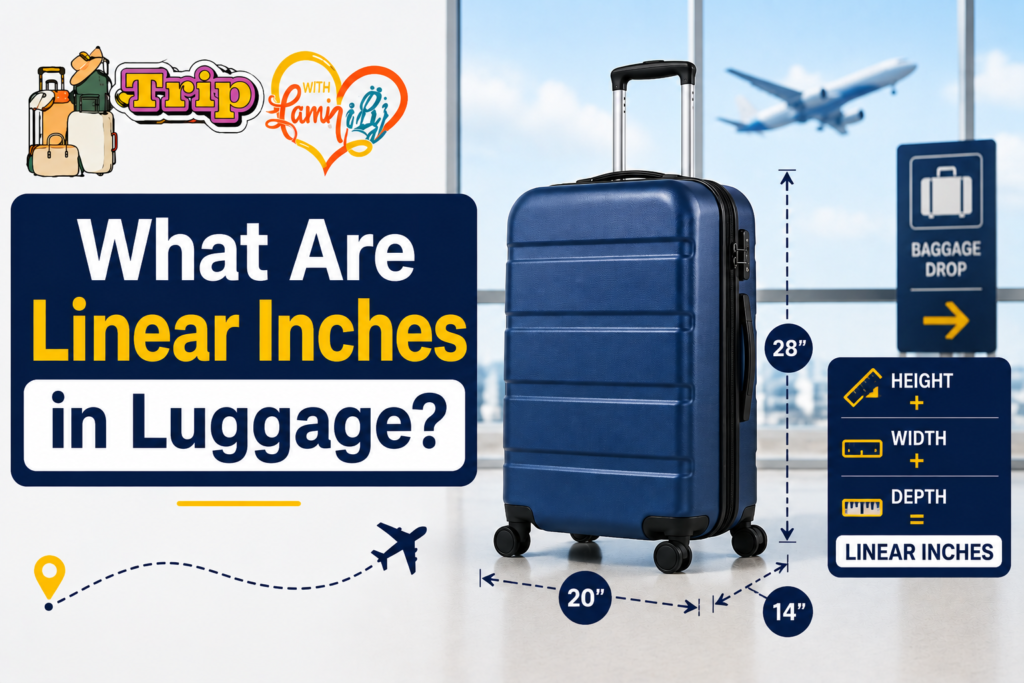
Linear inches are simply the total measurement of your suitcase.
Instead of measuring only the height, airlines add together:
- Height
- Width
- Depth
The total equals your luggage’s linear inches.
Formula
Height + Width + Depth = Linear Inches
For example:
| Dimension | Size |
|---|---|
| Height | 28 inches |
| Width | 20 inches |
| Depth | 14 inches |
| Total | 62 Linear Inches |
This is why you’ll often hear travelers mention the 62 linear inch rule.
Why Do Airlines Use Linear Inches?
Every suitcase has a different shape.
Some are taller.
Others are wider or deeper.
Using one total measurement makes baggage rules much easier for airlines to enforce.
Instead of creating separate limits for height, width, and depth, airlines simply measure the total dimensions.
This keeps the baggage allowance process consistent across thousands of different suitcase designs.
What Is the 62 Linear Inch Rule?
Most airlines allow checked luggage measuring up to 62 linear inches (158 cm).
That includes:
- Wheels
- Handles
- Exterior pockets
- Fixed attachments
Many travelers mistakenly measure only the main shell of the suitcase.
I made that mistake once, and it cost me an oversized baggage fee.
Always measure the entire suitcase, not just the storage compartment.
| Airline Standard | Typical Limit |
|---|---|
| Checked luggage size | 62 linear inches |
| Larger than 62 inches | Oversized baggage |
Learn more about: Checked Luggage Dimensions
How to Measure Your Suitcase Correctly
Measuring luggage only takes a minute.
Here’s the process I follow before every international trip.
Step 1
Measure the height from the floor to the highest point, including wheels and handles.
Step 2
Measure the widest part of the suitcase.
Step 3
Measure the depth from front to back.
Step 4
Add the three numbers together.
That’s your total linear inches.
| Measurement | Include? |
|---|---|
| Wheels | Yes |
| Handles | Yes |
| Exterior pockets | Yes |
| Interior storage | No |
Read the guide: How to Choose Luggage Size
Linear Inches vs Weight Limit
These are two completely different airline rules.
Many travelers confuse them.
| Size Rule | Weight Rule |
|---|---|
| Measures dimensions | Measures total weight |
| Uses linear inches | Uses pounds or kilograms |
| Determines oversized baggage | Determines overweight baggage |
Your luggage must satisfy both limits to avoid extra fees.
What Happens If Your Bag Exceeds 62 Linear Inches?
If your suitcase exceeds the airline’s size limit, several things may happen.
Depending on the airline, you might:
- Pay an oversized baggage fee
- Pay additional handling charges
- Be required to check the bag separately
- Face higher fees on international flights
Oversized luggage can become expensive very quickly.
That’s why I always measure my suitcase before leaving home.
Common Mistakes Travelers Make
After years of traveling, I’ve noticed the same mistakes happen repeatedly.
| Mistake | Better Approach |
|---|---|
| Measuring only suitcase height | Add height, width, and depth |
| Ignoring wheels | Measure the complete exterior |
| Assuming every airline is identical | Check airline baggage rules |
| Buying luggage without checking dimensions | Compare with airline limits first |
| Forgetting expandable sections | Measure after expansion |
Your ultimate solution: Carry-On Luggage Size Guide & Best Suitcases for Family Travel
Tips for Staying Within Airline Size Limits
A few simple habits have helped me avoid oversized baggage fees.
- Measure your suitcase before every trip.
- Buy luggage that stays below 62 linear inches.
- Avoid over-expanding expandable luggage.
- Check airline baggage policies before booking.
- Leave a little extra room instead of overpacking.
These small steps can save you a surprising amount of money over time.
Frequently Asked Questions
Are wheels included in linear inches?
Yes.
Airlines measure the complete outside dimensions, including wheels and handles.
Is 62 linear inches the same for every airline?
No.
Many airlines use the 62-inch rule, but some international and budget airlines have different baggage policies.
Can I bring luggage larger than 62 linear inches?
Usually yes, but you’ll likely pay oversized baggage fees, and some airlines have maximum limits beyond which the bag may require special handling.
Is linear inches only for checked luggage?
Mostly, yes.
Carry-on luggage usually follows individual height, width, and depth limits instead of the 62 linear inch rule.
Final Thoughts
Learning what are linear inches in luggage completely changed the way I shop for suitcases and prepare for flights. Once I understood how airlines measure baggage, avoiding oversized luggage became much easier.
Before your next trip, grab a measuring tape, check your suitcase dimensions, and compare them with your airline’s baggage policy. Spending just a few minutes at home can save you from expensive surprises at the airport.


