
When I packed for my first long-haul international trip years ago, I assumed my standard large suitcase would pass airport check-in without an issue. I only discovered the concept of linear inches after standing at the check-in counter, watching an airline agent pull out a tape measure and hit me with a steep oversized baggage fee.
That costly moment forced me to learn the exact rules surrounding luggage dimensions. Understanding what is 62 linear inch luggage size keeps your travel budget intact, prevents sudden airport stress, and helps you choose the right gear before you step out the door.
The Math Behind 62 Linear Inches
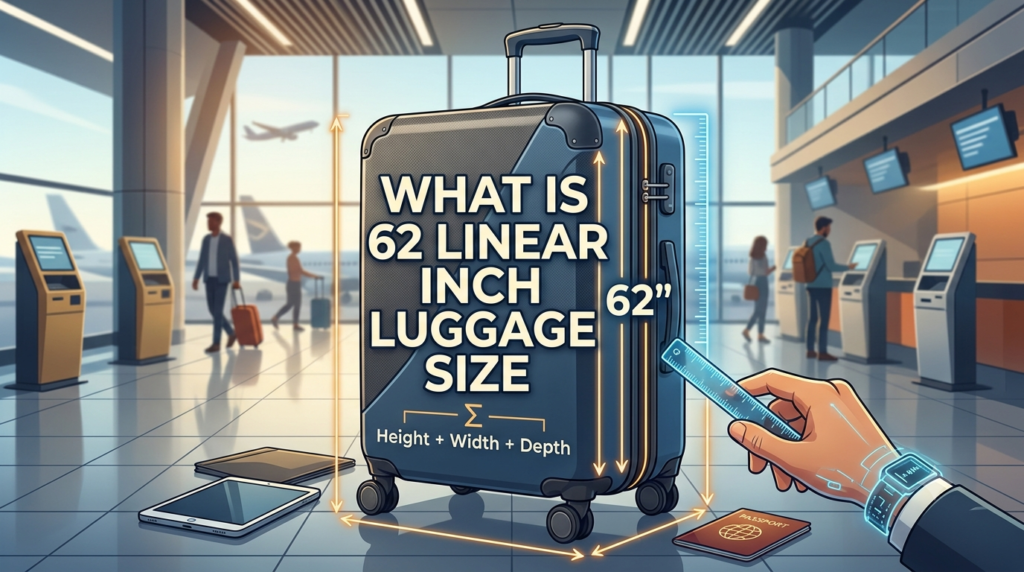
Linear measurement simply combines the exterior dimensions of your bag into one total number. Airlines use this single figure to standardize baggage limits across different bag shapes and designs.
To find your bag’s size, measure its length, width, and height in inches, then add those three numbers together. The maximum allowance for a standard checked bag on almost every major airline is 62 total inches.
| Dimension | Measurement Method | Common Bag Example |
| Length | Bottom to top, including wheels | 28 inches |
| Width | Side to side at widest point | 20 inches |
| Depth | Front to back, fully packed | 14 inches |
How to Calculate Your Bag Correctly
Measuring a suitcase seems simple until you miss the small parts that project outward. Airlines measure the absolute outer boundaries of your bag, not just the fabric body.
Always extend your tape measure from the floor to the top of the main carry handle. Be sure to include side handles, external pockets, and the full wheel housing in your final numbers.
| Measurement Point | Included in Total? | Why It Matters |
| Wheels & Casters | Yes | Adds 2 to 3 inches |
| Top & Side Handles | Yes | Adds up to 1 inch |
| Stuffed Side Pockets | Yes | Expands depth instantly |
You may also like to read: Family Packing List for Beach Vacation: What I Never Forget
Why 62 Linear Inches Matters to Major Airlines
Airlines set strict limits to optimize cargo space and protect baggage handlers from injury. A bag over 62 linear inches breaks standard sorting systems and requires special handling.
If your bag crosses this limit, it enters the oversized category. This classification triggers heavy fees regardless of whether your bag meets the standard weight limit.
| Airline Carrier | Standard Checked Limit | Oversized Category |
| Delta Air Lines | 62 Linear Inches | 63 to 80 Inches |
| American Airlines | 62 Linear Inches | 63 to 126 Inches |
| United Airlines | 62 Linear Inches | 63 to 115 Inches |
Oversized Baggage Fees You Want to Avoid
Paying an oversized fee is one of the quickest ways to ruin a travel budget. These extra charges apply per flight segment, meaning round trips double the cost.
Fee structures vary by carrier, but they generally start high. Keeping your bag within limits ensures you spend your money on your trip rather than airline penalties.
| Fee Type | Typical Cost | Common Trigger |
| Oversized Fee | $100 – $200 | Exceeding 62 Linear Inches |
| Overweight Fee | $100 – $200 | Exceeding 50 Pounds |
| Combined Penalty | $200 – $400 | Both Oversized and Overweight |
Common Suitcase Sizes That Equal 62 Linear Inches
Suitcase manufacturers design their largest standard checked bags specifically around the 62-inch threshold. These are typically marketed as 28-inch or 29-inch rolling suitcases.
Knowing standard dimensions makes shopping online much easier. It lets you spot compliant options without measuring every physical model in person.
Exterior vs. Interior Measurements
Retailers often advertise interior packing dimensions on the box. This marketing tactic leads many travelers to buy bags that fail airport limits once wheels are factored in.
Always check the product specifications for “total exterior dimensions” before buying. An interior 28-inch bag usually measures 30 to 31 inches on the outside.
| Marketed Bag Size | Exterior Dimensions | Total Linear Inches |
| 24-Inch Medium | 26 x 18 x 11 inches | 55 Linear Inches |
| 28-Inch Large | 30 x 19 x 13 inches | 62 Linear Inches |
| 30-Inch XL | 32 x 20 x 14 inches | 66 Linear Inches |
Packing Softside vs. Hardside Bags at Maximum Capacity
The material of your bag changes how its size behaves under pressure. A softside bag expands as you pack, while a hardside bag keeps a rigid outer shell.
I learned this lesson after overstuffing a soft canvas suitcase for a two-week trip. The bag met the 62-inch mark empty, but bulging front pockets pushed it to 65 linear inches at check-in.
Managing Softside Expansion Risks
Softside bags give you extra flex for souvenirs, but that flexibility carries a hidden risk. Zippered expansion gussets can add 2 to 3 inches to your bag’s depth in seconds.
If you use an expandable bag, measure it after it is fully packed. Keep heavy items centered so the front fabric does not balloon outward.
| Bag Style | Expansion Risk | Prevention Strategy |
| Softside Canvas | High | Avoid packing outer pockets |
| Hardside Polycarbonate | Low | Use internal compression straps |
| Duffel Bags | Very High | Pack in structured packing cubes |
Practical Tips for Measuring Luggage at Home
Measuring soft or curved luggage accurately takes a little technique. A flexible tailor’s tape works far better than a rigid metal construction measure.
Set your packed bag upright against a flat wall on a hard floor. Place a book flat across the top of the handle, then measure straight down to the floor for an exact height reading.
| Common Mistake | Why It Happens | Better Approach |
| Using Metal Tape | Bends around curves | Use tailor’s fabric tape |
| Measuring Empty | Ignores bag bulge | Measure fully packed bag |
| Skimping Wheels | Assumes wheels don’t count | Measure from floor up |
Final Thoughts
Navigating luggage restrictions comes down to knowing your gear before heading to the terminal. Once you realize what is 62 linear inch luggage size and how strictly airlines measure it, avoiding surprise fees becomes second nature.
Stick to standard 28-inch exterior bags, measure your gear fully packed, and watch out for bulging side pockets. A few minutes spent with a tape measure at home guarantees a smooth, stress-free start to your travel.


